Watch the Reflection
Meditate on the Seven Sorrows of the Blessed Virgin Mary — a powerful Marian devotion walking through the seven moments of deepest sorrow in Our Lady’s life. Watch the video above, or use the written reflection below to pray with each Sorrow in your own time. May Our Lady of Sorrows draw you close to the Heart of her Son, Jesus Christ, and console you in your own suffering.
The Seven Sorrows — Written Reflection
Read the Reflection
We can turn to Mary, our Lady of Sorrows, for consolation in our suffering. The Seven Sorrows of Mary invite us to walk with Our Lady through the deepest moments of her life — moments where love and grief meet, and where her faith becomes a model for our own.
First Sorrow — The Prophecy of Simeon
“And you yourself a sword will pierce.”
When Mary’s forty-day period of purification had almost ended, she goes to Jerusalem to fulfill the Mosaic Law and for the required offering to the Lord of every firstborn male. The law of purification does not bind Mary, always a virgin. Nor does Jesus, because of who He is, have to be redeemed. Yet Mary humbly obeys.
After the ceremony, imagine young Mary’s amazement when Simeon takes Jesus from her arms and acknowledges Him as Messiah. Only through divine inspiration can Simeon know this. Simeon blesses them and says to Mary, “And you yourself a sword will pierce.”
Mary shudders and holds Jesus close to her breast as Joseph gently leads her out of the temple. Although Joseph is deeply shaken, his primary concern is for his wife and son. They return to Nazareth in silence, where Mary ponders these things in her heart.
Second Sorrow — The Flight into Egypt
“The Angel of the Lord appeared to Joseph in a dream and said, ‘Rise, take the child and his mother, flee to Egypt, and stay there until I tell you. Herod is going to search for the child to destroy him.’”
Joseph hastily awakens Mary and relates his dream. She feels the sword’s sharpness as Simeon’s prophecy echoes in her heart. There is no time to worry — only time to pack a few essentials — as they prepare to flee to Egypt under the cover of darkness.
The lengthy journey across the desert wilderness frightens Mary, but she never voices her fears to Joseph. Yet she can’t help but think, “Will there be enough food and water? How will we weather the excessive heat? What if the donkey stumbles? What if…”
The “what-ifs” could have paralyzed a person of little faith. But Mary continues to trust that God will care for her little family’s needs. None of this is recorded, so we can only imagine the hardships that the Holy Family endured while in exile. One thing is certain: nothing can sway Mary’s trust in God. She never questions. She lets the things she doesn’t understand simply rest in her heart, in complete conformity to the divine plan. Mary is a model of cooperation with grace.
Third Sorrow — The Loss of the Child Jesus in the Temple
“After three days they found him in the temple, sitting in the midst of the teachers, listening to them and asking them questions. When his parents saw him, they were astonished. And his mother said to him, ‘Son, why have you done this to us? Your father and I have been looking for you with great anxiety.’”
Terror seizes Mary’s heart when she discovers that her Son is missing. On the third day, while walking by the temple, the anxious mother hears the sweet sound of Jesus’s voice.
“Joseph, look! There He is among the teachers!”
They run to Jesus’ side, and Mary, with mingled joy and sorrow, speaks the words of gentle reproach to her Son. Mary and Joseph realize they have a very special Son — one who amazes even the teachers in the temple with His intelligence.
Sometimes they whisper in Aramaic at night, sharing their innermost thoughts and concerns. Often, young Mary ponders these things in her heart while performing her daily tasks: grinding the grain into flour to make bread, milking the goats, and spinning yarn, weaving it into clothing for her family.
Sometimes, in the cool of evening, she sits on the flat roof of their home — the pain of Simeon’s prophecy and of Jesus’ disappearance merging and lingering — a pain as widespread as the profusion of flowers trickling down the hillside of Nazareth, in that April of Jesus’ twelfth year.
Fourth Sorrow — Mary Meets Jesus on the Way to the Cross
“And carrying the cross himself… A large crowd of people followed Jesus, including many women who mourned and lamented him.”
Mary’s life remains hidden — hidden in God. A widow now, she lives an inconspicuous life, pondering and accepting the mystery of her unique role, and that of her Son.
When news of His miracles reaches her at Nazareth, she rejoices. But the disturbing news of the tension mounting in Jerusalem concerning an upstart named Jesus makes her apprehensive. She knows the sword is poised to pierce her heart more deeply.
Yet she goes to Jerusalem for the Passover feast, hoping Jesus will be there. Mary helps prepare the Passover meal. Quickly, she dishes out the bitter herbs and vinegar and carries them to the Upper Room. Here, Mary participates in the first Eucharist. She comprehends all too well the full meaning of His words.
We can only guess at the sequence of events. Perhaps one of the holy women finds Mary and tells her that Jesus has been arrested. “I must go to Him!” she cries. Mary pushes her way through the shouting, cursing mob. At last, she sees her Son carrying His cross. Mary’s heart breaks in unspeakable sorrow at the outrage committed against His precious body. She is powerless to minister to Him except by her presence.
Their eyes meet and speak volumes of love in a frozen moment of anguished silence. “Trust, trust,” Jesus’ heart speaks to hers. His unspoken words echo in her hearing heart. With renewed strength, she walks the Way of her Son.
Fifth Sorrow — Mary Stands at the Foot of the Cross
“Standing by the cross of Jesus were his mother and his mother’s sister, Mary the wife of Clopas, and Mary of Magdala. When Jesus saw his mother and the disciple there whom he loved, he said to his mother, ‘Woman, behold your son.’ Then he said to the disciple, ‘Behold, your mother.’ And from that hour, the disciple took her into his home.”
Finally, they reach the hill of execution. The cruel soldiers stretch Jesus’ battered body onto the cross and, with heavy hammer blows, drive the sharp spikes into His hands and feet. Mary’s head pounds with each cruel blow. No one hears the silent scream that shatters her broken heart and echoes in the Heart of God.
What now takes place is all according to God’s plan. Her Son, the Son of God, has to suffer and die. John, the beloved disciple, puts his arms around Mary, steadying her. “My precious child,” she weeps, “heralded at Bethlehem. Now suffering an ignominious and painful death!”
And then through swollen purple lips, Jesus speaks. Mary strains to hear His words. He looks tenderly upon His mother, and with great effort says, “He is your son.” He looks at the disciple and emphasizes, “She is your mother.”
Sixth Sorrow — Mary Receives the Body of Jesus from the Cross
“After this, Joseph of Arimathea, secretly a disciple of Jesus for fear of the Jews, asked Pilate if he could remove the body of Jesus. And Pilate permitted it. So he came and took the body.”
Saying, “It is finished,” Jesus bows His head and dies. Mary remembers His words at the Passover meal: “This cup is the new covenant in my blood, which will be shed for you.”
The dreaded time is now: the Precious Blood of her Son is poured out for all humankind. The covenant is sealed. Jesus, her Son, the Son of God, is dead. In her heart, Mary dies with Him. Two broken hearts — one pierced with a spear, one pierced with sorrow — become one: Jesus and Mary, forever united for the whole human family.
Mary’s sorrow is all the greater because of the greatness of her love. Jesus’ body is taken down from the cross and placed in her arms. Mary embraces her Son with a love beyond words, beyond grief itself.
For now, it is the grief of a consummate sorrow. She, who had given birth to divinity, now presses the bloodied and battered remains of His humanity close to her sorrowful and shattered heart. “Let it be done according to Thy will, Lord,” she prays.
Seventh Sorrow — The Burial of Jesus
“The women who had come from Galilee with him followed behind, and when they had seen the tomb and the way in which his body was laid in it, they returned and prepared spices and perfumed oils.”
The holy women quietly prepare the spices and ointments, and gather the winding sheet and the grave cloth, according to Jewish custom. Mary, the faithful disciple, insists on helping and returns to the tomb with the women. They go about their task of washing the body with great reverence and wrap it in long strips of linen, taking great care to pack the fragrant spices — including the myrrh and aloes Nicodemus had brought — between the cloth and the body, in order to reduce the stench of death.
Mary hesitates before placing the grave cloth over Jesus’ face. Tenderly, she kisses Him, one last lingering time. John steps forward to take her hand and lead her to his home. Behind them, they hear the heavy round stone rolled forward to seal the cave.
Mary’s pierced heart remains united to the stilled heart of the One they had pierced — the most Sacred Heart that was formed in her immaculate womb. With one languishing wail, she proclaims what others are just now beginning to believe, what she already knew:
“My Lord, and my God.”
A Prayer to Our Lady of Sorrows
O most holy Virgin, Mother of our Lord Jesus Christ, by the overwhelming grief you experienced when you witnessed the martyrdom, crucifixion, and death of your divine Son, look upon me with eyes of compassion, and awaken in my heart a tender commiseration for those sufferings, as well as a sincere detestation of my sins, in order that, being disengaged from all undue affection for the passing joys of this earth, I may sigh after the eternal Jerusalem, and that henceforward all my thoughts and all my actions may be directed toward this one most desirable object. Amen.
Continue Your Devotions:
After meditating on the Seven Sorrows of Mary, you may wish to continue with these other devotions from the Sacred Heart Ministry:
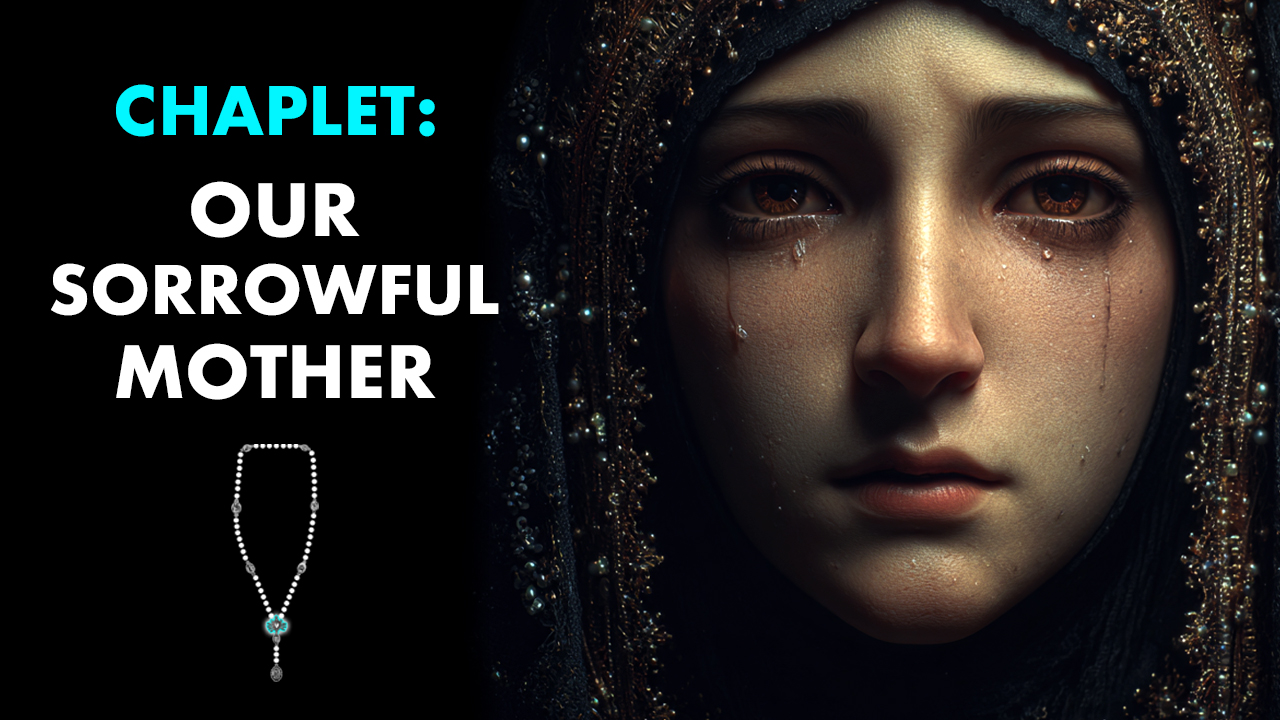
Chaplet of Our Sorrowful Mother
Learn More About Our Lady of Sorrows
Leave a Reply